
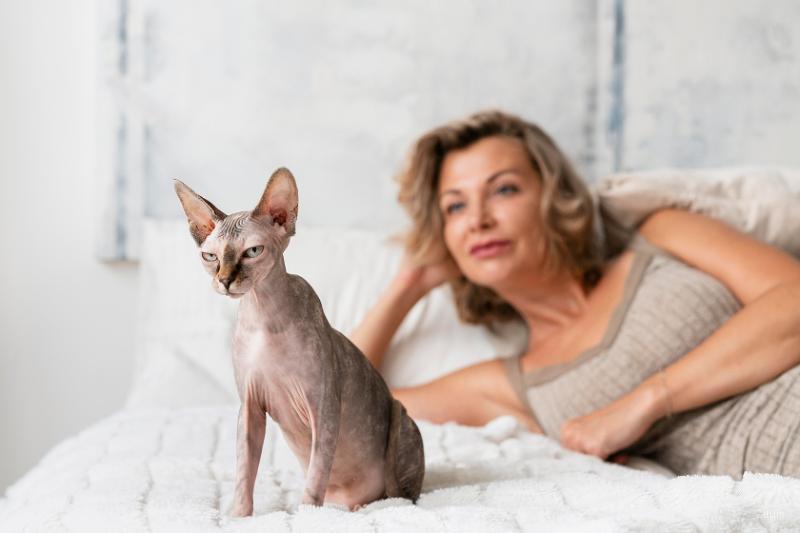
Sphynx
Last Updated:
The Sphynx cat breed is a unique, hairless, and affectionate companion known for its wrinkled skin and large ears. Popular among exotic pet lovers in India, Sphynx cats are highly social, intelligent, and thrive on human attention. They require regular skin care and a warm indoor environment.
Height
8 - 10 inches
Intelligence
High
Lifespan
8 - 14 years
Weight
3 - 6 kg
Temperament
About
The Sphynx is a distinctive and affectionate cat breed best known for its hairless appearance, large ears, prominent cheekbones, and wrinkled skin. Despite its lack of a traditional fur coat, the Sphynx is warm, social, playful, and highly people-oriented. It often enjoys staying close to its owners and actively participating in household activities.
Sphynx cats are known for being affectionate, intelligent, energetic, social, playful, curious, and attention-seeking. They often form strong bonds with their families and may follow their owners around the home. Their highly social personality means they generally enjoy regular human interaction and can become bored or lonely when left alone for extended periods.
Although Sphynx cats are commonly described as hairless, their skin is usually covered by a very fine layer of peach-fuzz-like hair. Their lack of a dense coat means they require specific skin care and protection from excessive sun exposure and cold temperatures. They are best suited to indoor living in a comfortable, temperature-controlled environment.
Sphynx Cat Appearance
The Sphynx has a distinctive appearance characterized by its nearly hairless body, large ears, prominent cheekbones, muscular build, and wrinkled skin. Their skin can display many different colors and patterns, similar to the coat colors seen in fully furred cats.
Common physical characteristics of a Sphynx include:
- Medium-sized body
- Muscular and athletic build
- Broad chest
- Large ears
- Prominent cheekbones
- Large, expressive eyes
- Long tail
- Wrinkled skin
- Very fine hair or peach-fuzz-like covering
Sphynx cats can occur in a wide variety of colors and patterns because their skin pigmentation reflects many of the colors and patterns that would appear in a furred cat.
Sphynx Cat Temperament
The Sphynx temperament is generally affectionate, outgoing, playful, curious, intelligent, and highly social. These cats often seek human companionship and enjoy being involved in whatever their owners are doing.
Many Sphynx cats are comfortable around visitors and may actively approach people for attention. They can be particularly affectionate and may enjoy sitting on laps, sleeping beside their owners, or following family members around the home.
Are Sphynx Cats Good Family Pets?
Yes, Sphynx cats can make excellent family pets for households that can provide plenty of companionship and appropriate care. Their playful and affectionate personality makes them highly interactive companions.
They generally enjoy being around people and can adapt well to active households. However, their social nature means they may not be ideal for families where the cat would routinely be left alone for long periods.
Are Sphynx Cats Good with Children?
Sphynx cats can get along well with children when properly socialized and treated gently. Their playful and outgoing personality can make them entertaining companions for families.
Children should be taught to handle the cat carefully and respect its boundaries. Because Sphynx cats have little protective fur, rough handling can also cause skin irritation or injury.
Sphynx Cat Intelligence and Training
Sphynx cats are intelligent and curious and can learn household routines, tricks, interactive games, and simple behaviors through positive reinforcement.
Mental stimulation can include:
- Puzzle feeders
- Interactive toys
- Clicker training
- Fetch
- Food-based games
- Simple tricks
- Interactive play
Short, rewarding training sessions can help channel their intelligence and prevent boredom.
Sphynx Cat Exercise Requirements
Sphynx cats are generally active and playful and benefit from regular daily exercise. They enjoy climbing, jumping, chasing toys, and interactive games.
Suitable activities include:
- Interactive wand toys
- Cat trees
- Scratching posts
- Climbing shelves
- Chasing games
- Puzzle toys
- Interactive feeders
- Fetch
Regular exercise helps maintain healthy muscles and provides an outlet for their natural curiosity and energy.
Can Sphynx Cats Live in Apartments?
Yes, Sphynx cats can adapt very well to apartment living. Their social personality and indoor lifestyle make them suitable for homes where owners can provide regular companionship.
Owners should provide scratching posts, climbing structures, interactive toys, comfortable sleeping areas, and plenty of opportunities for play and exploration.
Sphynx Cat Grooming Requirements
Although Sphynx cats do not have a conventional fur coat, they are not completely maintenance-free. Their skin produces natural oils that would normally be absorbed by fur, so oil can accumulate on the skin and require regular cleaning.
Basic grooming and skin care should include:
- Regular bathing as advised by a veterinarian or based on skin oil buildup
- Gentle skin cleaning
- Regular ear cleaning
- Nail trimming
- Dental care
- Routine veterinary examinations
The frequency of bathing varies between individual cats because some produce more skin oil than others. Excessive bathing can also dry or irritate the skin, so a gentle routine is important.
Do Sphynx Cats Shed?
Sphynx cats do not shed fur in the same way as fully coated breeds because they have very little visible hair. However, they can still shed tiny amounts of fine hair and produce skin oils and dander.
The absence of a conventional fur coat does not mean the breed is completely allergen-free.
Are Sphynx Cats Hypoallergenic?
No, Sphynx cats are not considered hypoallergenic. Cat allergies are primarily associated with proteins such as Fel d 1, which are present in saliva and skin secretions rather than simply fur.
People with cat allergies should spend time around a Sphynx before deciding to bring one home.
Sphynx Cat Health
Sphynx cats require regular veterinary examinations, vaccinations, parasite prevention, dental care, balanced nutrition, and appropriate weight management.
Because of their breed characteristics, owners should pay particular attention to skin health, ear health, dental hygiene, and protection from temperature extremes. Sphynx cats can also be predisposed to certain inherited conditions, including hypertrophic cardiomyopathy (HCM).
Responsible breeders should consider appropriate health screening, and regular veterinary examinations can help identify potential problems early.
What Should You Feed a Sphynx Cat?
A Sphynx should receive a complete and balanced diet appropriate for its age, size, activity level, and individual health requirements.
Sphynx cats are often energetic and may have relatively high food requirements compared with less active cats. However, portions should still be appropriate for maintaining a healthy body condition.
Fresh drinking water should always be available.
Sphynx Cat Socialization
Early socialization can help Sphynx kittens become confident and comfortable around different people, household sounds, handling, grooming, and appropriately introduced pets.
Because Sphynx cats are naturally social, positive experiences with people and other animals can help them develop into friendly and adaptable companions.
Are Sphynx Cats Good with Other Pets?
Sphynx cats can generally get along well with other cats and cat-friendly dogs when introduced gradually and appropriately. Their social and playful nature can make them suitable for multi-pet households.
Introductions should be gradual and supervised, with each pet having access to separate food, water, litter, and resting areas.
Are Sphynx Cats Affectionate?
Yes, Sphynx cats are widely known for being highly affectionate and people-oriented. Many enjoy sitting on laps, sleeping close to their owners, following family members around the house, and seeking physical contact.
Their warm skin and love of body heat can also make them particularly fond of cuddling and sleeping under blankets.
Are Sphynx Cats Vocal?
Sphynx cats can be fairly vocal and communicative. They may use meows, chirps, trills, and other sounds to interact with their owners.
Their vocalization level varies between individuals, but their social nature often means they enjoy communicating with people.
Are Sphynx Cats Good for First-Time Cat Owners?
Sphynx cats can be suitable for first-time cat owners who are prepared for their specific skin care, temperature management, social, and veterinary needs.
They may require more hands-on care than a typical short-haired cat because their skin needs regular attention and they should be protected from excessive cold and direct sunlight.
Do Sphynx Cats Need a Lot of Attention?
Yes, Sphynx cats are highly social and generally enjoy significant interaction with their owners. They can become bored or lonely when left alone for long periods.
Regular play, companionship, interactive toys, and mental stimulation are important for their emotional wellbeing.
How Long Do Sphynx Cats Live?
Sphynx cats can commonly live around 12 to 15 years or longer with appropriate nutrition, preventive veterinary care, responsible breeding, and a healthy indoor lifestyle. Individual lifespan varies depending on genetics and overall health.
Sphynx Cat Price in India
The Sphynx cat price in India can vary depending on pedigree, breeder reputation, lineage, health screening, age, location, and availability.
As a general estimate, a Sphynx kitten in India may cost approximately ₹50,000 to ₹1,50,000 or more.
Imported or exceptionally well-bred kittens may cost considerably more because of transportation, documentation, health checks, and limited availability.
Prospective owners should consider health records, vaccination history, parental health, kitten socialization, living conditions, and responsible breeding practices rather than choosing a kitten based solely on price.
Sphynx Cat Monthly Maintenance Cost in India
The estimated Sphynx cat monthly maintenance cost in India can range from approximately ₹4,000 to ₹9,000 or more, depending on food, litter, skincare products, healthcare, grooming, preventive treatments, toys, and lifestyle.
Regular expenses may include:
- Quality cat food
- Cat litter
- Skin and bathing supplies
- Routine veterinary care
- Vaccinations
- Parasite prevention
- Dental care
- Toys and enrichment
- Temperature control during extreme weather
Can Sphynx Cats Live in India's Climate?
Sphynx cats can live in India, but they require careful temperature management. They have very little protective fur and can become uncomfortable in both cold and extreme heat.
During cooler weather, provide warm bedding, blankets, and a comfortable indoor temperature. During hot weather, provide shade, fresh water, good ventilation, and a cool indoor environment while limiting direct sunlight.
Do Sphynx Cats Get Cold Easily?
Yes, Sphynx cats can become cold more easily than cats with normal fur because they lack a dense insulating coat. Warm bedding, blankets, and a comfortable indoor environment are particularly important during colder months.
Clothing can sometimes be used if the individual cat tolerates it, but it should never restrict movement or cause overheating or skin irritation.
Can Sphynx Cats Get Sunburned?
Yes, Sphynx cats have less natural protection from sunlight because of their minimal coat. Prolonged direct sun exposure can increase the risk of sunburn and other skin damage.
Keeping them indoors and limiting direct sunlight is the safest approach. Any sunscreen or skin product should only be used under veterinary guidance because some human products can be harmful to cats.
Are Sphynx Cats High-Maintenance?
Sphynx cats have relatively low fur-grooming requirements but can be considered higher-maintenance in other areas. Their skin requires regular care, their ears may need frequent cleaning, and they need protection from temperature extremes and excessive sunlight.
Their highly social personality also means they benefit from substantial daily interaction and companionship.
Do Sphynx Cats Need Baths?
Sphynx cats may need regular bathing because their skin produces oils that are not absorbed by a normal fur coat. However, the ideal bathing frequency varies between individual cats.
Bathing should be gentle and should not be excessive, as over-bathing can dry or irritate the skin. A veterinarian can recommend an appropriate skincare routine if a cat has recurring skin problems.
Final Thoughts
The Sphynx is a unique, affectionate, intelligent, and highly social cat breed known for its nearly hairless appearance, large ears, wrinkled skin, playful personality, and strong attachment to people.
For prospective owners in India, it is important to consider both the Sphynx cat price in India and ongoing costs for food, litter, skincare, healthcare, temperature control, and enrichment before bringing one home.
With appropriate nutrition, regular veterinary care, consistent skin and ear care, protection from extreme temperatures and sunlight, daily interaction, and a safe indoor environment, the Sphynx can be a loving and highly interactive companion for individuals and families.
Care Requirements
Compatibility
Available Colors
Health Considerations
- Hypertrophic cardiomyopathy
- Skin Problems due to lack of fur
Fun Facts
- The modern Sphynx cat originated in the 1960s in Toronto, Canada, from a natural genetic mutation causing hairlessness.
- The first known Sphynx cat was a kitten named Prune, born in 1966, which became the foundation of the breed.
Frequently Asked Questions
Common questions about the Sphynx breed.
What is a Sphynx cat?
The Sphynx is a distinctive, nearly hairless cat breed known for its warm, soft skin, large ears, prominent cheekbones, muscular body, and affectionate personality. Despite its appearance, Sphynx cats can have a fine layer of downy hair.
How much does a Sphynx cat cost in India?
The Sphynx cat price in India can vary depending on pedigree, breeder reputation, lineage, health screening, age, location, and availability. A kitten may typically cost around ₹50,000 to ₹1,50,000 or more.
Are Sphynx cats good family pets?
Yes, Sphynx cats can make excellent family pets. They are affectionate, outgoing, intelligent, playful, and highly social. They generally enjoy being involved in family activities and spending time with their owners.
Are Sphynx cats good with children?
Sphynx cats can be good with children when properly socialized and treated gently. Their playful and affectionate nature can make them enjoyable family companions. Children should be taught that their skin is delicate and should never be handled roughly.
Are Sphynx cats good with other pets?
Yes, Sphynx cats generally enjoy the companionship of other cats and can get along with cat-friendly dogs when introduced gradually. They are highly social and may benefit from having another compatible pet in the household.
Are Sphynx cats affectionate?
Yes, Sphynx cats are particularly known for being affectionate and people-oriented. They often follow their owners around the home, seek physical contact, and enjoy sleeping close to their families.
Are Sphynx cats lap cats?
Many Sphynx cats enjoy sitting on laps and cuddling with their owners. They are attracted to body heat and often prefer staying close to people, although individual preferences vary.
Are Sphynx cats easy to train?
Sphynx cats are intelligent and food-motivated and can learn tricks, fetch, routines, and other behaviors through positive reinforcement. Clicker training and puzzle-based activities can provide useful mental stimulation.
How much exercise does a Sphynx cat need?
Sphynx cats are active and playful and benefit from daily interactive exercise. Wand toys, chasing games, climbing structures, puzzle feeders, and fetch can help keep them physically and mentally stimulated.
Can Sphynx cats live in apartments?
Yes, Sphynx cats can adapt very well to apartment living. They are primarily indoor cats and benefit from cat trees, scratching posts, interactive toys, warm resting areas, and regular human companionship.
Do Sphynx cats shed?
Sphynx cats have very little visible hair and are considered low-shedding, but they are not completely hairless. Fine down may cover parts of their body, and they still produce skin oils and dander.
How often should a Sphynx cat be bathed?
Sphynx cats may require regular bathing because their skin produces natural oils that are not absorbed by a normal fur coat. The ideal frequency varies between cats, and excessive bathing can dry or irritate the skin. A veterinarian can recommend an appropriate routine.
Are Sphynx cats hypoallergenic?
No, Sphynx cats are not considered hypoallergenic. Cat allergens are found in substances such as saliva and skin secretions rather than only in fur. People with allergies should spend time around a Sphynx before adopting one.
Are Sphynx cats vocal?
Sphynx cats can be quite communicative. They may use meows, chirps, trills, and other sounds to interact with their owners. They are not necessarily loud, but they should not be considered a particularly quiet breed.
What should I feed a Sphynx cat?
A Sphynx should receive a complete and balanced diet appropriate for its age, size, activity level, and health requirements. Because they are active and have high energy needs, appropriate nutrition and portion control are important.
What is the monthly maintenance cost of a Sphynx cat in India?
The estimated Sphynx cat monthly maintenance cost in India can range from approximately ₹4,000 to ₹9,000 or more. Expenses may include food, litter, skincare products, veterinary care, vaccinations, parasite prevention, dental care, toys, and enrichment.
How long do Sphynx cats live?
Sphynx cats can commonly live around 12 to 15 years or longer with appropriate nutrition, responsible breeding, regular veterinary care, and a healthy indoor lifestyle.
Are Sphynx cats suitable for first-time cat owners?
Sphynx cats can be suitable for first-time owners who are prepared for their special skincare, ear care, temperature management, social, and veterinary needs. They generally require more hands-on care than many short-haired breeds.
Do Sphynx cats need a lot of attention?
Yes, Sphynx cats are highly social and generally need considerable human interaction. They can become lonely or bored if left alone for long periods, so daily companionship, play, and enrichment are important.
Are Sphynx cats active?
Yes, Sphynx cats are active, playful, and curious. They enjoy climbing, jumping, exploring, chasing toys, and participating in household activities.
Do Sphynx cats get cold easily?
Yes, Sphynx cats can become cold more easily because they lack a dense insulating coat. Warm bedding, blankets, and a comfortable indoor temperature are important, particularly during colder weather.
Can Sphynx cats get sunburned?
Yes, their minimal coat provides limited protection from direct sunlight. Sphynx cats should be kept indoors and protected from prolonged direct sun exposure. Any sunscreen or skin product should only be used under veterinary guidance.
Do Sphynx cats need special skin care?
Yes. Sphynx cats produce natural skin oils that can accumulate on their skin. Regular gentle bathing, appropriate skin care, and routine checks can help maintain healthy skin. Over-bathing should be avoided because it can cause dryness and irritation.
Do Sphynx cats need their ears cleaned?
Yes, Sphynx cats can accumulate more wax and debris in their ears because they have little or no ear hair. Their ears should be checked regularly and cleaned when necessary using veterinarian-approved products.
Do Sphynx cats have health problems?
Sphynx cats can be predisposed to certain health conditions, including hypertrophic cardiomyopathy, hereditary myopathy, periodontal disease, and some skin conditions. Responsible breeders should use appropriate health screening, and regular veterinary examinations are important.
What is hypertrophic cardiomyopathy in Sphynx cats?
Hypertrophic cardiomyopathy, or HCM, is a heart disease involving thickening of the heart muscle. It can occur in Sphynx cats, so prospective owners should ask breeders about cardiac screening and discuss appropriate heart monitoring with their veterinarian.
Are Sphynx cats completely hairless?
No. Sphynx cats are not necessarily completely hairless. Many have a very fine layer of down that can feel like soft peach skin, and some may have small amounts of fine hair on areas such as the nose, ears, feet, or tail.
Can Sphynx cats live in India's climate?
Sphynx cats can live in India but require careful temperature management. During hot weather, they need shade, fresh water, good ventilation, and protection from direct sunlight. During colder weather, warm bedding and a comfortable indoor temperature are important.
Are Sphynx cats high-maintenance?
Yes, Sphynx cats can be considered higher-maintenance despite having very little hair. Their skin requires regular care, their ears need routine monitoring, and they need protection from excessive heat, sunlight, and cold. Their social nature also means they need plenty of companionship.
Can Sphynx cats be left alone?
Sphynx cats generally do not do well when left alone for long periods because they are highly social and people-oriented. They are often happiest when they have regular human interaction or a compatible animal companion.
Do Sphynx cats like to sleep with their owners?
Many Sphynx cats enjoy sleeping close to their owners because they seek warmth and companionship. They may sleep under blankets or beside their owners, although individual sleeping preferences vary.