Birman
Last Updated:
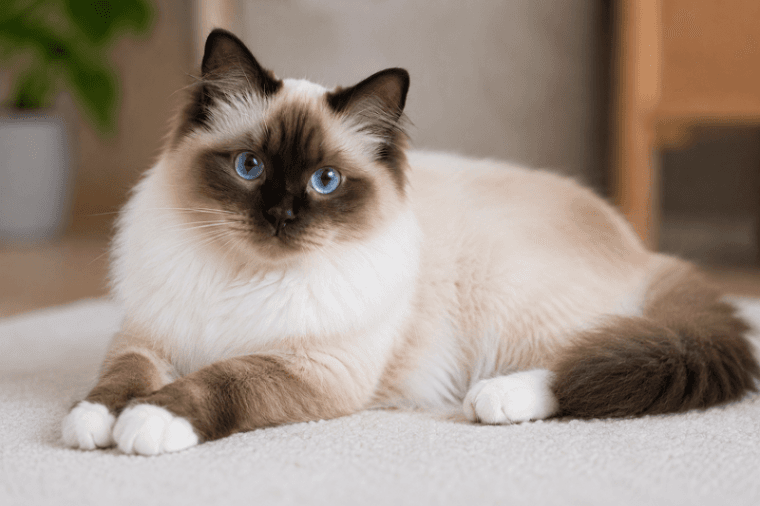
The Birman is a gentle, affectionate, and elegant cat breed known for its silky colorpoint coat, deep blue eyes, and distinctive white "gloves" on its paws. Calm yet playful, Birmans are devoted family companions that thrive on love and companionship.
Height
10 - 12 Inches
Intelligence
High
Lifespan
12 - 16 Years
Weight
3.5 - 6.5 Kg
Temperament
About
The Birman, also known as the Sacred Cat of Burma, is an elegant medium-to-large cat breed known for its striking blue eyes, silky semi-long coat, color-point markings, and distinctive white paws. Birmans are affectionate, gentle, social, and known for forming strong bonds with their families.
Birman cats are generally affectionate, gentle, intelligent, playful, social, calm, and people-oriented. They enjoy companionship and often prefer staying close to their owners without being excessively demanding.
The Birman's silky coat is relatively easy to maintain compared with many other longhaired breeds. Its characteristic color-point pattern, deep blue eyes, and symmetrical white gloves and laces on the paws give the breed its distinctive appearance.
Birman Appearance
Birmans have a sturdy yet elegant body, broad head, expressive blue eyes, and medium-to-long legs. Their most recognizable features are their pointed coloration, white paws, and silky coat.
Common physical characteristics include:
- Medium-to-large body
- Strong, sturdy build
- Broad, rounded head
- Medium-sized ears
- Large, deep blue eyes
- Medium-length legs
- Large, rounded paws
- Medium-length tail
- Silky semi-long coat
- Color-point markings
- Distinctive white gloves and laces on the paws
Birmans are born mostly white, with their point coloration developing as they grow. Common point colors include seal, blue, chocolate, lilac, red, and cream, along with various tortie and lynx patterns depending on the registry.
Birman Temperament
The Birman temperament is generally affectionate, gentle, calm, intelligent, playful, and social. They often develop strong bonds with their owners and enjoy being involved in household activities.
Birmans are usually less demanding than some highly active breeds but still enjoy regular interaction, play, and companionship. They can be an excellent choice for people looking for a loving and sociable cat.
Are Birman Cats Good Family Cats?
Yes, Birman cats can make excellent family companions. Their gentle and affectionate nature allows them to adapt to many household environments.
They generally do best in homes where they receive regular companionship, affection, play, and mental stimulation.
Are Birman Cats Good with Children?
Yes, Birmans can be good with children when properly socialized and treated respectfully. Their patient and gentle personality can make them suitable family companions.
Children should be taught to handle cats gently and respect their boundaries, especially when the cat is eating, sleeping, or seeking a quiet space.
Birman Intelligence and Training
Birmans are intelligent and curious cats that can learn household routines, interactive games, and simple tricks. They generally respond well to positive reinforcement.
Training can include:
- Responding to their name
- Clicker training
- Simple tricks
- Harness training
- Fetch-style games
- Puzzle feeders
Short training sessions using treats, praise, and play can provide useful mental stimulation.
Birman Exercise Requirements
Birmans have moderate activity needs. They enjoy interactive play, climbing, chasing toys, and exploring, while also spending plenty of time relaxing with their families.
Suitable activities include:
- Interactive wand toys
- Chasing games
- Cat trees
- Scratching posts
- Puzzle feeders
- Fetch-style games
- Interactive toys
Regular play helps maintain muscle tone, healthy weight, and mental stimulation.
Can Birman Cats Live in Apartments?
Yes, Birman cats can adapt well to apartment living. Their calm and adaptable nature makes them suitable for indoor homes, provided they receive regular play and companionship.
They should have access to scratching posts, climbing structures, comfortable resting areas, and interactive toys.
Birman Grooming Requirements
The Birman has a silky semi-long coat that generally does not mat as easily as some other longhaired breeds. Regular brushing helps remove loose hair and keep the coat smooth.
Basic grooming should include:
- Brushing one to two times a week
- More frequent brushing during seasonal shedding
- Regular nail trimming
- Routine ear checks
- Regular dental care
- Bathing only when necessary
Gentle brushing is usually sufficient to maintain the coat and reduce loose hair around the home.
Do Birman Cats Shed a Lot?
Birmans shed moderately, with shedding often increasing during seasonal coat changes. Regular brushing can help manage loose hair and reduce the formation of tangles.
Are Birman Cats Hypoallergenic?
No, Birman cats are not considered hypoallergenic. Their silky coat does not eliminate cat allergens, and people with cat allergies may still react to them.
Birman Health
Birmans are generally healthy cats, but like other breeds, they can be susceptible to certain inherited and common feline health conditions.
Potential concerns include hypertrophic cardiomyopathy, kidney disease, dental disease, obesity, and gastrointestinal problems.
Regular veterinary examinations, vaccinations, parasite prevention, dental care, appropriate nutrition, and healthy weight management are important for maintaining good health.
Are Birman Cats Prone to Heart Problems?
Hypertrophic cardiomyopathy, or HCM, can occur in cats, including Birmans. Regular veterinary examinations can help monitor overall heart health and identify potential abnormalities.
Breathing difficulty, weakness, fainting, or sudden changes in activity should be evaluated promptly by a veterinarian.
Are Birman Cats Prone to Kidney Problems?
Kidney disease can occur in Birmans as well as other cats. Adequate hydration, appropriate nutrition, regular veterinary examinations, and routine blood and urine testing as recommended by a veterinarian can help monitor kidney health.
Are Birman Cats Prone to Obesity?
Birmans can gain excess weight if calorie intake consistently exceeds their energy needs. Portion control, regular play, and monitoring body condition can help maintain a healthy weight.
Are Birman Cats Prone to Dental Problems?
Like other cats, Birmans can develop plaque, tartar, gingivitis, and periodontal disease. Regular tooth brushing and veterinary dental examinations can help maintain good oral health.
What Should You Feed a Birman Cat?
A Birman should receive a complete and balanced diet appropriate for its age, activity level, size, and health.
High-quality wet food, dry food, or an appropriate combination can provide suitable nutrition when properly formulated and portioned.
Fresh, clean drinking water should always be available.
Are Birman Cats Good with Other Cats?
Yes, Birmans can generally live well with other cats when properly socialized and introduced. Their social and gentle nature can make them good companions for compatible cats.
Introductions should be gradual, with separate food, water, litter, and resting areas for each cat.
Are Birman Cats Good with Dogs?
Yes, Birmans can get along well with cat-friendly dogs when properly introduced and socialized. Their calm and adaptable personality can help them adjust to multi-pet households.
The cat should always have access to elevated spaces and safe areas where it can retreat.
Are Birman Cats Affectionate?
Yes, Birman cats are known for being affectionate and devoted to their families. They often enjoy staying close to their owners and participating in household activities.
Are Birman Cats Lap Cats?
Many Birmans enjoy sitting on laps and cuddling with their owners. They often appreciate physical affection while still being playful and curious when they are active.
Are Birman Cats Vocal?
Birmans can be communicative but are generally not considered excessively vocal. They may use soft meows, chirps, and other sounds to interact with their owners.
Are Birman Cats Aggressive?
Birman cats are generally gentle, friendly, and social rather than inherently aggressive. Individual behavior depends on genetics, socialization, handling, environment, and experiences.
Early socialization and positive handling can help develop a confident and well-adjusted cat.
Are Birman Cats Good for First-Time Cat Owners?
Yes, Birmans can be suitable for first-time cat owners who want an affectionate, gentle, social, and relatively easy-going companion.
Owners should be prepared to provide regular grooming, companionship, appropriate nutrition, play, and preventive veterinary care.
Do Birman Cats Need a Lot of Attention?
Birmans enjoy human companionship and generally benefit from regular interaction and affection. They are social cats and often prefer being near their family rather than being isolated for long periods.
Can Birman Cats Be Left Alone?
Birman cats can spend reasonable periods alone when provided with a safe and enriched environment. However, they are social cats and generally prefer regular companionship and interaction.
Long periods of isolation should be avoided whenever possible.
How Long Do Birman Cats Live?
Birman cats commonly live around 12 to 16 years or more with appropriate care. Individual lifespan varies depending on genetics, nutrition, preventive veterinary care, lifestyle, and overall health.
How Big Do Birman Cats Get?
Birmans are medium-to-large cats with a sturdy build. Adult males are generally larger than females, although individual size can vary depending on genetics and overall health.
What Colors Do Birman Cats Come In?
Birmans have a color-point pattern with a lighter body and darker coloration on the face, ears, legs, and tail. Common point colors include seal, blue, chocolate, lilac, red, and cream, along with tortie and lynx variations.
What Is the Birman Coat Like?
The Birman has a silky, semi-long coat with relatively little undercoat. This makes it less prone to severe matting than some other longhaired breeds, although regular brushing is still recommended.
Why Do Birman Cats Have White Paws?
The distinctive white paws of the Birman are known as gloves. The breed standard also describes white markings extending upward on the back of the hind legs, known as laces. These markings are among the breed's most recognizable features.
Are Birman Cats Born White?
Yes, Birman kittens are born with very light or white coats. Their darker point coloration develops gradually as they mature, making their characteristic markings more visible over time.
Can Birman Cats Live in India's Climate?
Birman cats can live in India's climate with appropriate care. During hot and humid weather, they should have access to a cool indoor environment, fresh water, shade, good ventilation, and comfortable resting areas.
Do Birman Cats Need Air Conditioning in India?
Air conditioning can be helpful during India's hottest summer periods, particularly in regions with extreme heat and humidity. Fresh water, ventilation, shade, and cool resting spaces are also important.
Are Birman Cats High-Maintenance?
Birmans have moderate grooming requirements, but their silky coat is relatively easy to maintain compared with many longhaired breeds. They also need regular companionship, play, dental care, and preventive veterinary care.
Are Birman Cats Good for Active Families?
Yes, Birmans can be excellent companions for families that enjoy interacting with their pets. They enjoy play and exploration but also have a calm and affectionate side.
Are Birman Cats Good for Indian Families?
Birman cats can be suitable for Indian families that can provide companionship, regular grooming, appropriate nutrition, preventive veterinary care, indoor enrichment, and protection from extreme heat.
Birman Price in India
The Birman price in India can vary depending on pedigree, breeder reputation, bloodline, health screening, age, location, coat color, and availability.
Because Birmans are relatively uncommon in India, availability can be limited and prices may vary considerably.
Prospective owners should consider vaccination records, health history, parental health, living conditions, responsible breeding practices, and the kitten's overall health rather than choosing a kitten based solely on price.
Birman Monthly Maintenance Cost in India
The estimated Birman monthly maintenance cost in India can vary depending on food, litter, grooming, veterinary care, parasite prevention, dental care, toys, and lifestyle.
Regular expenses may include:
- Quality cat food
- Cat litter
- Routine veterinary care
- Vaccinations
- Deworming
- Parasite prevention
- Grooming supplies
- Dental care
- Toys and enrichment
Final Thoughts
The Birman is an affectionate, gentle, intelligent, and social cat breed recognized for its beautiful blue eyes, silky color-point coat, and distinctive white paws. Its balanced personality makes it a rewarding companion for families and individuals alike.
For prospective owners in India, it is important to consider the Birman price in India as well as ongoing expenses for quality nutrition, litter, grooming, veterinary care, parasite prevention, dental care, toys, and enrichment.
With responsible breeding, appropriate nutrition, regular veterinary care, routine grooming, positive socialization, daily interaction, and protection from extreme heat, a Birman can be a loving and devoted family companion for many years.
Care Requirements
Compatibility
Available Colors
Health Considerations
- Hypertrophic Cardiomyopathy (HCM)
- Polycystic Kidney Disease (Rare)
- Obesity
- Dental Disease
- Feline Infectious Peritonitis
Fun Facts
- According to legend, the Birman's beautiful blue eyes and white-gloved paws were gifts from a golden-eyed goddess after a loyal temple cat courageously protected its fallen priest, giving rise to the breed's mystical appearance.
- If you love Ragdoll cats, you have the Birman to thank! The Ragdoll breed was originally developed in the 1960s by crossing Birman and Persian-type cats.
Frequently Asked Questions
Common questions about the Birman breed.
What is a Birman cat?
The Birman, also known as the Sacred Cat of Burma, is a medium-to-large cat breed known for its silky semi-long coat, deep blue eyes, color-point markings, and distinctive white gloves and laces.
How much does a Birman cat cost in India?
The Birman price in India varies depending on pedigree, breeder reputation, bloodline, health screening, age, location, coat color, and availability. Since Birmans are relatively uncommon in India, prices can vary considerably.
Are Birman cats good family pets?
Yes, Birmans are excellent family cats. They are gentle, affectionate, social, playful, and generally adapt well to different household environments.
Are Birman cats good with children?
Yes, Birmans can be very good with children. Their patient, gentle, and tolerant personality makes them suitable for families when children are taught to handle cats respectfully.
Are Birman cats good with other cats?
Yes, Birmans generally get along well with other cats when properly introduced. Their social nature means many enjoy having feline companionship.
Are Birman cats good with dogs?
Yes, Birmans can get along well with cat-friendly dogs when properly introduced. Their calm and adaptable temperament can make them suitable for multi-pet households.
Are Birman cats affectionate?
Yes, Birmans are highly affectionate and people-oriented. They often enjoy staying close to their owners and may follow them around the home.
Are Birman cats lap cats?
Yes, many Birmans enjoy sitting on laps and being held. They are known for enjoying physical affection and relaxing close to their caregivers.
Are Birman cats intelligent?
Yes, Birmans are intelligent and curious cats. They can learn household routines, interactive games, simple tricks, and can enjoy puzzle toys.
Are Birman cats easy to train?
Birmans generally respond well to positive reinforcement. Their intelligence and people-oriented nature can make training for tricks, games, and harness walking enjoyable.
How much exercise does a Birman cat need?
Birmans have moderate activity needs. Daily interactive play, chasing games, climbing structures, and puzzle toys can help keep them physically active and mentally stimulated.
Can Birman cats live in apartments?
Yes, Birmans can adapt well to apartment living. They should have access to scratching posts, climbing areas, comfortable resting spaces, interactive toys, and regular play.
Do Birman cats need outdoor access?
No, Birmans can live happily indoors when provided with enough enrichment and companionship. If outdoor activity is desired, supervised harness walks or a secure cat enclosure are safer options.
Do Birman cats shed a lot?
Birmans generally shed less than many other long-haired cats. Their single silky coat is less prone to matting, although seasonal shedding can increase during spring.
How often should a Birman cat be groomed?
Weekly combing is generally sufficient to keep a Birman's silky coat in good condition and remove loose hair. More frequent grooming may be useful during seasonal shedding.
Do Birman cats need professional grooming?
Most Birmans do not require regular professional grooming. Routine brushing at home, along with nail trimming, ear care, and dental care, is usually sufficient.
Are Birman cats hypoallergenic?
No, Birman cats are not considered hypoallergenic. Their silky coat does not eliminate cat allergens, and people with cat allergies may still react to them.
Are Birman cats healthy?
Birmans are generally healthy cats, but like all breeds they can develop inherited or common feline health conditions. Regular veterinary examinations and preventive care are important.
Are Birman cats prone to heart problems?
Hypertrophic cardiomyopathy, or HCM, can occur in Birmans. Responsible breeding programs may use health screening, while regular veterinary examinations can help monitor overall heart health.
Are Birman cats prone to kidney problems?
Kidney disease can occur in Birmans as it can in other cats. Good hydration, appropriate nutrition, regular veterinary examinations, and recommended blood and urine testing can help monitor kidney health.
Are Birman cats prone to obesity?
Birmans can gain excess weight if calorie intake exceeds their energy needs. Portion control, regular play, appropriate nutrition, and monitoring body condition can help maintain a healthy weight.
Are Birman cats prone to dental problems?
Like other cats, Birmans can develop plaque, tartar, gingivitis, and periodontal disease. Regular tooth brushing and veterinary dental examinations can help maintain good oral health.
What should I feed a Birman cat?
A Birman should receive a complete and balanced diet appropriate for its age, activity level, size, and health. Wet food, dry food, or an appropriate combination can be suitable when properly formulated and portioned.
Do Birman cats need a lot of water?
Fresh, clean water should always be available. Multiple water sources or a cat water fountain can encourage good hydration, particularly for cats that eat mostly dry food.
Are Birman cats vocal?
Birmans are generally relatively quiet and have a soft, pleasant voice. They may use gentle meows, chirps, and other sounds to communicate with their owners.
Are Birman cats aggressive?
Birmans are generally gentle, friendly, and tolerant rather than inherently aggressive. Individual behavior depends on genetics, socialization, handling, environment, and experiences.
Are Birman cats good for first-time cat owners?
Yes, Birmans can be excellent for first-time cat owners who want a gentle, affectionate, social, and relatively easy-to-groom companion.
Do Birman cats need a lot of attention?
Birmans enjoy human companionship and benefit from regular attention and interaction. They are social cats and generally prefer being around people or other pets rather than being isolated.
Can Birman cats be left alone?
Birmans can spend reasonable periods alone when provided with a safe and enriched environment, but they are social cats that generally prefer companionship. Long periods of isolation should be avoided.
How long do Birman cats live?
Birmans commonly live around 9 to 15 years or more with appropriate care. Some can live beyond 15 years depending on genetics, nutrition, preventive veterinary care, and lifestyle.
How big do Birman cats get?
Birmans are medium-to-large cats with a sturdy, heavily boned build. Males are generally larger than females, although individual size varies.
What colors do Birman cats come in?
Birmans are color-pointed cats and are recognized in several point colors, including seal, blue, chocolate, lilac, red, and cream, as well as tortie and lynx point variations.
What color eyes do Birman cats have?
Birman cats have deep blue to sapphire-blue eyes. Blue eyes are one of the breed's most distinctive characteristics.
What is the Birman coat like?
The Birman has a soft, silky semi-long coat with relatively little undercoat. Its coat is less prone to matting than that of many other long-haired breeds.
Why do Birman cats have white paws?
The Birman's distinctive white paws are called gloves. The hind legs also have white markings extending upward, known as laces. These symmetrical markings are a defining feature of the breed.
Are Birman cats born white?
Yes, Birman kittens are born very light or white. Their darker point coloration develops gradually as they mature.
Can Birman cats learn tricks?
Yes, Birmans are intelligent and can learn tricks, fetch, puzzle games, and other interactive activities using positive reinforcement.
Can Birman cats walk on a leash?
Yes, many Birmans can learn to walk on a harness and leash. Training should be gradual and positive, beginning indoors before introducing the cat to outdoor environments.
Can Birman cats live in India's climate?
Birman cats can live in India with appropriate care. During hot and humid weather, they should have access to a cool indoor environment, fresh water, shade, good ventilation, and comfortable resting areas.
Do Birman cats need air conditioning in India?
Air conditioning can be helpful during India's hottest summer periods, particularly in areas with extreme heat and humidity. Fresh water, ventilation, shade, and cool resting spaces are also important.
Are Birman cats high-maintenance?
Birmans have moderate grooming needs, but their silky single coat is relatively easy to maintain and less prone to matting. Their social nature means they also benefit from regular companionship and interaction.
Are Birman cats good for active families?
Yes, Birmans can be excellent companions for families. They enjoy interactive play and exploration while also having a calm and affectionate side.
Are Birman cats good for Indian families?
Birmans can be suitable for Indian families that can provide companionship, regular grooming, appropriate nutrition, preventive veterinary care, indoor enrichment, and protection from extreme heat.
What is the monthly maintenance cost of a Birman in India?
The monthly maintenance cost of a Birman in India varies depending on food, litter, grooming, veterinary care, parasite prevention, dental care, toys, and lifestyle. Owners should also budget separately for vaccinations and unexpected veterinary expenses.
What kind of owner is best for a Birman?
A Birman is best suited to an owner or family looking for a gentle, affectionate, intelligent, social, and relatively easy-to-groom cat and who can provide regular companionship, quality nutrition, enrichment, and preventive veterinary care.